What to do with your Christmas tree after the holidays


Don’t just drag your Christmas tree to the curb on January 2nd. That six-foot Noble Fir (Abies procera) or Douglas Fir (Pseudotsuga menziesii) took seven to ten years to grow. It has more useful life in it. You can mulch it, sink it in a pond, turn it into bird habitat, chip it for garden paths, or compost the needles. Americans buy roughly 25 to 30 million real Christmas trees every year, and most end up in landfills where they take up space and produce methane as they decompose. That’s a waste of perfectly good organic material.
For a deeper look at every recycling method, we break down the full list of options. But here are the ones I’ve actually used, along with what works and what doesn’t.
How do city Christmas tree recycling programs work?
Most cities run Christmas tree collection and chipping programs in early January. In Sacramento and most Bay Area cities, curbside pickup runs the first two weeks of January. San Jose, Oakland, and San Francisco all operate free drop-off sites at parks and recycling centers. Sacramento recycled over 500 tons of Christmas trees in a single year, and that chipped material generated enough energy to power 20,000 homes for a month through biomass energy conversion.
Here’s what your city program typically offers:
- Curbside pickup on designated dates (usually January 2-15)
- Drop-off locations at parks, recycling centers, or fire stations
- Free mulch from chipped trees, available for pickup in late January or February
Call your city’s waste management department or check their website in late December. The schedule fills up fast. Remove every ornament, every strand of tinsel, every light, and the tree stand before putting it out. Flocked trees (the ones sprayed with fake snow) are usually rejected by chipping programs because the flock chemicals contaminate the mulch. If your tree is flocked, it goes in the regular trash. Keep that in mind before you buy next year.
Can you use a Christmas tree as mulch in your garden?
Yes, and this is probably the best use for it. A single Christmas tree yields a surprising amount of material. Here’s how to put it to work.
Chip the branches for mulch. If you own a chipper (or can rent one for about $75-150/day from Home Depot or a local rental shop), run the branches through it. Spread the chips 2-3 inches deep around acid-loving plants like blueberries, azaleas, rhododendrons, and camellias. Conifer chips lower soil pH slightly as they decompose, which those plants love. Don’t pile chips against the trunk of any tree or shrub. Leave a 3-4 inch gap around the base to prevent rot and pest problems. The International Society of Arboriculture recommends keeping mulch 2-4 inches deep and always away from the trunk.
Cut branches for winter plant protection. Lay cut boughs over perennial beds, strawberry crowns, and tender plants to provide winter insulation through January and February. The needles catch snow, which is actually one of the best natural insulators for plant roots. Remove the boughs in early March when the ground starts to thaw and new growth begins.
Compost the needles. Pine and fir needles break down slowly (12-18 months), but they add carbon and improve airflow in dense compost piles. Mix them with nitrogen-rich green material like grass clippings or kitchen scraps at roughly a 3:1 ratio (carbon to nitrogen). Contrary to a persistent myth, conifer needles in compost do not make your compost significantly acidic. By the time they fully decompose, the pH is close to neutral.
Use the trunk for garden path edging. Split the trunk into rounds with a handsaw or hatchet. Each round makes a rustic stepping stone or path border. One tree won’t give you much, but if you do this every January, you’ll have a full path border in four or five years.
How do you sink a Christmas tree for fish habitat?
If you have a pond on your property (or know someone who manages a private pond or lake), a Christmas tree makes excellent underwater fish structure. The Texas Parks and Wildlife Department, Missouri Department of Conservation, and several other state agencies actively encourage this practice and have published guidelines for it.
Sunk in 6 to 10 feet of water, the branches provide cover for bluegill, crappie, and bass fry. Algae and aquatic insects colonize the branch surfaces within weeks, creating a food chain that starts with microorganisms and works up to game fish. Larger bass and catfish use the structure as ambush points.
How to do it right:
- Wire the trunk to two or three concrete blocks (not cinder blocks, which can crumble) using galvanized wire
- Position the tree upright or at an angle so branches spread out at multiple depths
- Place it at least 20 feet from shore in water 6-10 feet deep
- One or two trees per quarter-acre of pond surface is the right ratio
- Don’t use flocked trees or trees treated with preservatives
Check with your state fish and wildlife agency before sinking trees in public waterways. Most states require a permit for that. Private ponds on your own property are usually fine.
Turn it into a backyard bird shelter
This is the easiest option and the one I recommend if you’re short on time. Prop the stripped Christmas tree in a corner of your yard, near a fence or existing shrubs. Hang suet cakes, seed bells, and dried orange halves from the branches. Set it within view of a window so you can watch.
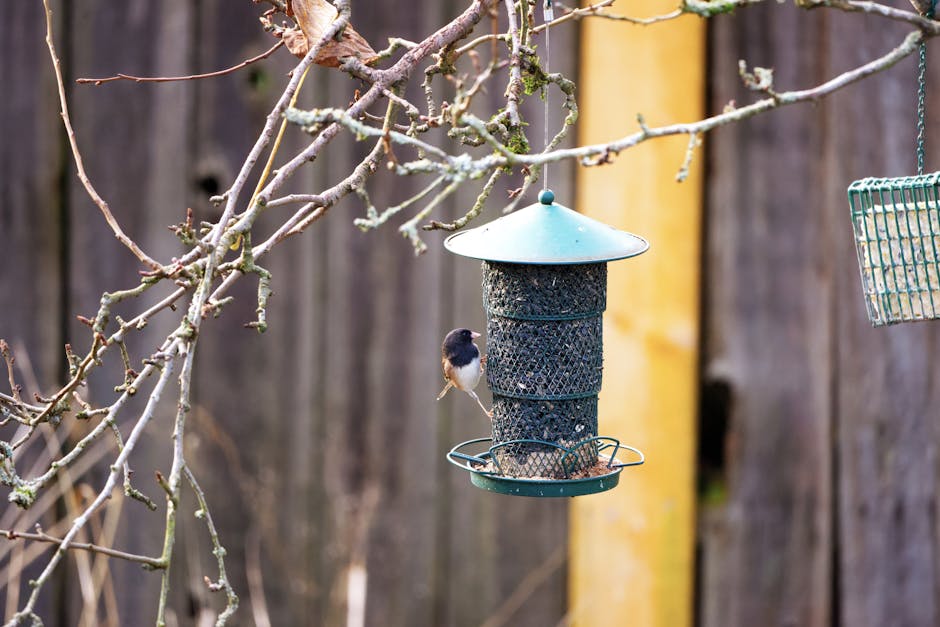
Juncos, chickadees, towhees, and sparrows will use the dense branches for shelter from wind and rain through the rest of winter. In Northern California, Anna’s Hummingbirds overwinter and will perch in the protected interior branches between feeding runs.
The birds will strip the suet clean in a few weeks. By late February or early March, the tree will be dry, brittle, and easy to break apart for the green waste bin or chipper. You get two months of bird activity from a tree that was headed for the landfill.
If you want to get more permanent wildlife into your yard, our guide to the best trees for your yard covers species that attract birds year-round.
What about building something with it?
Christmas tree wood is soft. Most common species sold as Christmas trees (Noble Fir, Douglas Fir, Fraser Fir, Scots Pine) have straight-grained, easy-to-carve wood. You won’t build furniture from it, but smaller projects work well.
Trunk cross-sections (cut into 1-2 inch thick rounds) make rustic coasters, candle platforms, or plant pot stands. Sand them smooth and apply a coat of polyurethane or tung oil. The end grain shows a nice pattern, especially on fir species.
Branch sections make decent stakes for garden plants, frames for small trellises, or material for kids’ building projects. The bark peels easily once the wood dries for a couple of weeks indoors.
For more ideas on turning tree material into garden features, check out our piece on creative uses for tree stumps.
Why you should never burn it in the fireplace
I know it’s tempting. You’ve got a dry tree, you’ve got a fireplace, it’s cold outside. Don’t do it.
Dry pine and fir ignite fast and burn extremely hot. A Christmas tree can fully engulf in flames in under 30 seconds (the National Fire Protection Association has tested this). That rapid combustion sends superheated gases and heavy resin-laden smoke straight up your chimney. The resin condenses as creosote on your flue liner. Creosote is the number one cause of chimney fires, and a chimney fire can cost $1,000-3,000 to repair the liner, or burn your house down if it breaches.
Beyond the chimney risk, burning a whole tree or large sections in a fireplace can overwhelm the firebox. The flames can extend above the opening, and the radiant heat can crack the firebox or ignite nearby combustibles.
If you want to burn sections of the trunk, do it in an outdoor fire pit, cut into small pieces (12 inches or shorter), and give it plenty of ventilation. Even outdoors, dry conifer needles pop and throw sparks 6-8 feet. Keep the pit at least 20 feet from structures, fences, and dry grass. California fire codes require a minimum 10-foot clearance from combustible structures for recreational fires, but 20 feet is smarter.
What about flocked or artificial trees?
Flocked trees (sprayed with artificial snow coating) cannot be recycled through municipal chipping programs. The flock contains chemicals that contaminate wood chip mulch. Your only option is the regular trash or green waste if your hauler accepts them. Some communities accept flocked trees separately and send them to biomass energy plants instead of chipping them for mulch.
Artificial trees don’t decompose. The average artificial tree is used for about 6 years before being discarded, and they’ll sit in a landfill for centuries. If you switch to artificial, use it for at least 10-15 years to offset the environmental cost of manufacturing (most are made from PVC and steel produced in China). If your artificial tree is still in good shape but you’re done with it, donate it to Goodwill, Habitat for Humanity ReStore, or a local church.
The best approach: plan before you buy
If you know you want to mulch or compost your tree, buy an unflocked Noble Fir or Douglas Fir. They chip well and their needles decompose faster than pine. Noble Fir (Abies procera) is native to the Pacific Northwest mountains, growing in zones 5-6, while Douglas Fir (Pseudotsuga menziesii) ranges more widely through zones 4-6. Neither grows naturally in the Sacramento Valley floor, but both are the most popular Christmas tree species sold here because they hold their needles well indoors. If you want to sink it in a pond, Scots Pine (Pinus sylvestris) holds its branches longer underwater.
For winter landscaping purchases and planning ahead, buying your Christmas tree from a local lot (not a big box store) often means the tree was cut more recently, holds needles longer, and supports a local grower.
For year-round tree care after the holidays, our spring tree care checklist picks up where Christmas tree recycling leaves off. And if this year’s tree inspired you to plant something permanent, our guide to the best trees for fall color covers species that’ll give you that same evergreen satisfaction without the annual disposal question.