Best fertilizer for palm trees

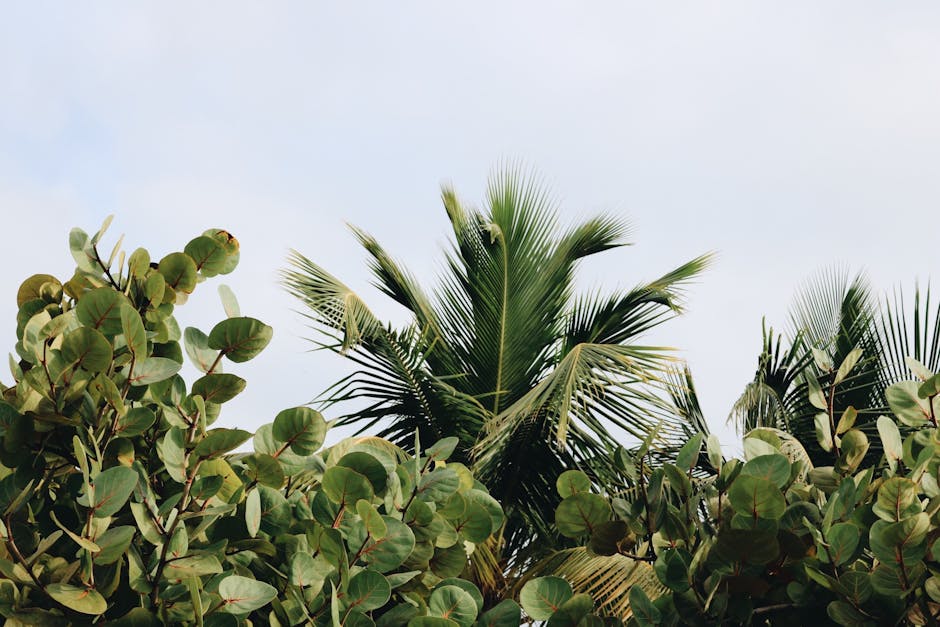
The best fertilizer for palm trees is a slow-release granular formula with an 8-2-12 or 8-4-12 NPK ratio plus magnesium, manganese, iron, and boron. Regular tree fertilizer won’t cut it. Palms are heavy potassium and magnesium feeders with specific micronutrient needs that standard 10-10-10 or lawn fertilizer completely ignores. Use a product labeled specifically for palms, apply it three times per year from April through September, and your fronds will stay green from base to tip.
I’ve grown palms in Northern California for over 15 years. The biggest mistake I see neighbors make is treating palms like any other tree. They dump lawn fertilizer around the base, wonder why the fronds turn yellow, then assume the tree is dying. It’s not dying. It’s starving for potassium and manganese while drowning in nitrogen it doesn’t need.
Why do palm trees need special fertilizer?
Palms aren’t like oaks or maples. They’re monocots, more closely related to grass than to hardwood trees. Their nutrient needs are completely different from the deciduous trees in your yard.
Palms burn through potassium faster than almost any other landscape plant. Potassium deficiency is the number one nutritional problem in palms, and it shows up as yellowing and browning on older fronds that gradually works its way up the canopy. A standard balanced fertilizer like 10-10-10 doesn’t provide nearly enough potassium relative to nitrogen. Too much nitrogen with too little potassium actually makes the deficiency worse by pushing new growth that pulls potassium from the older fronds.
Magnesium is the other big one. Palms need it for chlorophyll production, and most soils in Northern California don’t supply enough. A magnesium-deficient palm develops broad yellow bands along the edges of older fronds while the center stays green. It looks like the leaf is fading from the outside in.
Then there are the micronutrients. Manganese and iron deficiencies cause “frizzle top,” where new fronds emerge stunted, curled, and necrotic. I’ve seen Canary Island Date Palms in Sacramento with frizzle top so bad the new growth looked like crumpled brown paper. A $20 bag of palm fertilizer with manganese sulfate would have prevented it entirely.
Which palm species actually grow in Northern California?
Not every palm belongs here. But several species do well in zones 8b through 10a, and a few are genuinely worth planting.
Mexican Fan Palm (Washingtonia robusta) is the tall, skinny one you see everywhere along California boulevards. It grows fast and tops out at 70-100 feet. Personally, I wouldn’t plant one in a residential yard. They get too tall for safe maintenance, the dead fronds are a fire hazard, and a professional trim costs $200-400 once a year when they’re mature. They also drop heavy fruit clusters that stain driveways.
California Fan Palm (Washingtonia filifera) is the native species. Stockier trunk, wider canopy, maxes out around 40-60 feet. Better proportioned for a large yard. Zones 8b-11. Still a big tree though.
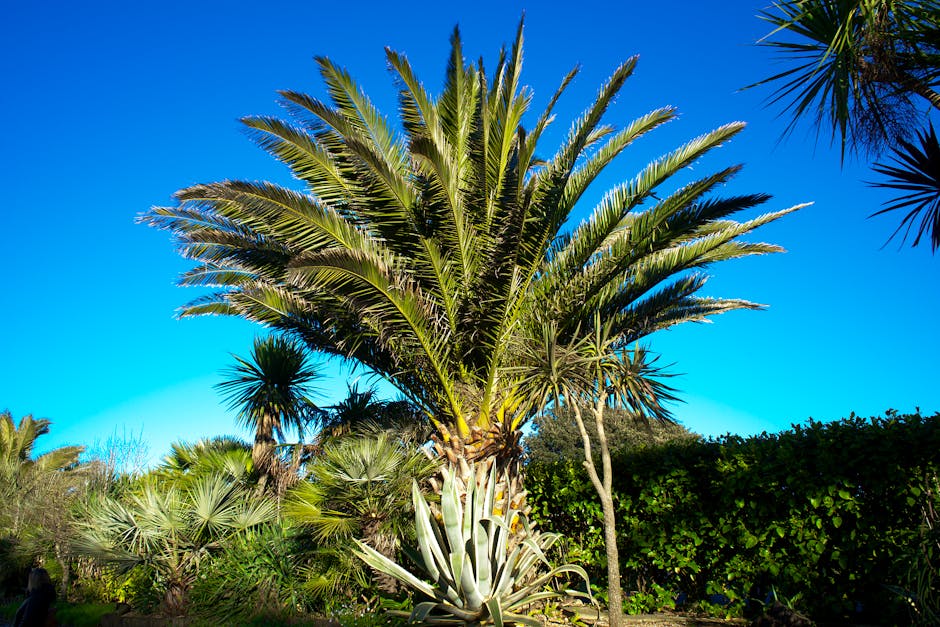
Canary Island Date Palm (Phoenix canariensis) is the statement tree. Massive trunk, huge crown of arching fronds. Gorgeous in the right spot. They run $500-3,000 for a 15-gallon to specimen-size tree at the nursery, and they need a lot of room. If you’ve got the space and budget, this is the one that makes your yard look like a resort. Zones 9-11 reliably, with some surviving in zone 8b against south-facing walls.
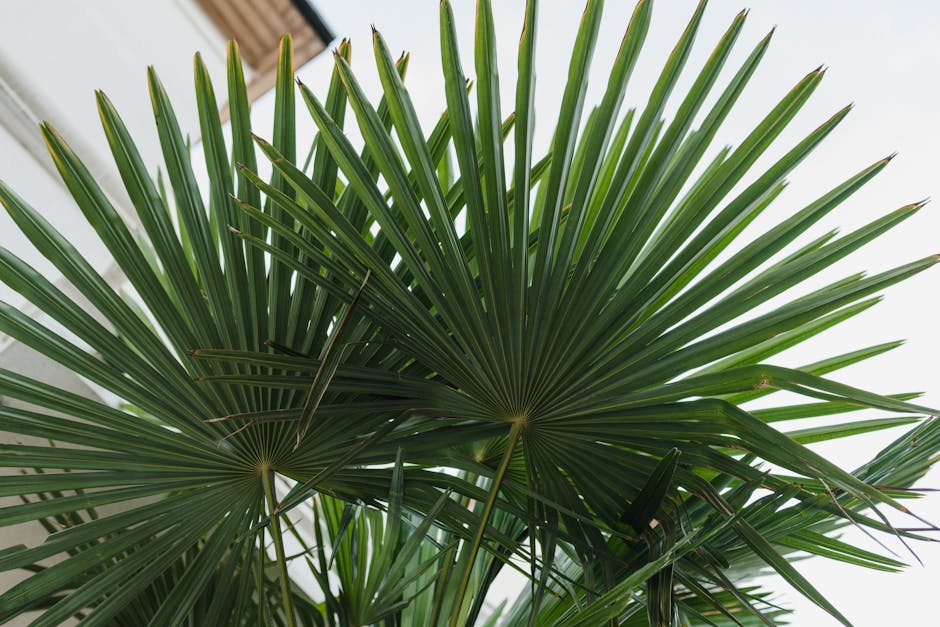
Mediterranean Fan Palm (Chamaerops humilis) is my top pick for NorCal yards. It stays under 15 feet, handles cold down to zone 8a (around 10 degrees F), and the multi-trunk form looks good as a focal point or screen. If you’re looking for a compact option for a smaller lot, this palm actually works. Low maintenance, slow growing, and tough.
Windmill Palm (Trachycarpus fortunei) is the cold-hardiest palm you can grow here. Survives down to zone 7b (5 degrees F). Tops out around 25 feet with a narrow canopy. The hairy trunk is distinctive. Grows well in the Bay Area, Sacramento, and even foothill communities where other palms would freeze.
Both the Mediterranean Fan Palm and Windmill Palm are reasonable choices for a normal residential lot. The others are for big properties or people who really want that tropical look and are willing to pay for maintenance.
What does palm nutrient deficiency look like?
Knowing the symptoms saves you money. Catch problems early and a $20 bag of fertilizer fixes them. Wait too long and you’re looking at a dead palm and a $1,500 removal bill.
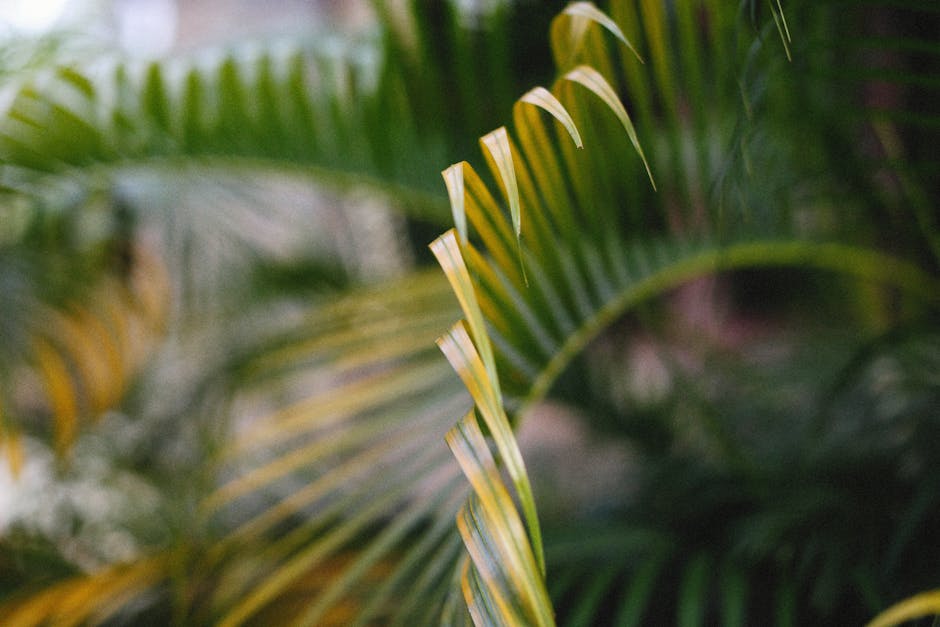
Potassium deficiency is the most common. Older, lower fronds develop translucent yellow or orange spots. The tips and margins turn brown and crispy. Over time, the browning moves upward through the canopy. In severe cases, the trunk narrows at the top (“pencil pointing”) because new growth is undersized. Potassium-deficient palms are also more vulnerable to cold damage.
Magnesium deficiency shows up as bright yellow bands along the leaf margins of older fronds. The center of the leaf stays green. It looks different from potassium deficiency because the yellowing is along the edges, not spotty throughout. Common in sandy or acidic soils.
Manganese deficiency causes frizzle top. New emerging fronds come out stunted, with small, curled leaflets that are yellow or brown and necrotic at the tips. In bad cases the new spear leaf dies before it even opens. This is the one that panics people because it hits the top of the tree where new growth should be healthy. Alkaline soils (pH above 7.0) lock out manganese even when it’s present in the soil. Most of the Central Valley and Sacramento area has alkaline soil.
Iron deficiency also hits new growth. Young fronds come out uniformly yellow or light green with thin green veins. Similar to iron chlorosis in citrus. Same cause too: high soil pH. Chelated iron (EDDHA form) corrects it, but a palm-specific fertilizer with iron sulfate handles mild cases during regular feeding.
What is the best fertilizer for palm trees to buy?
Here are the products I’ve used or seen work well in NorCal yards. All are slow-release granular formulas designed specifically for palms.
Jobe’s Palm Tree Fertilizer Spikes (10-5-10) run about $12-15 for a pack of 6 spikes. You hammer them into the ground around the drip line. Easy to apply, no mess. The ratio isn’t ideal (I’d prefer more potassium), but they include manganese, iron, and magnesium. Good enough for small palms like Mediterranean Fan or Windmill.
Sunniland Palm Fertilizer (8-2-12) costs about $18-22 for a 20-pound bag. This is closer to the ideal ratio. High potassium, low phosphorus, good micronutrient package. Hard to find outside Florida and the South, but you can order it online. If you can get it, this is the one to use.
Miracle-Gro Shake ‘n Feed Palm Plant Food (8-2-12) is the easiest to find locally. About $15-18 for a 4.5-pound jug at Home Depot or Lowe’s. Same good ratio as Sunniland. Contains magnesium, iron, and manganese. Feeds for up to 3 months. This is what I keep in my garage and use on my Windmill Palms and Mediterranean Fan Palm.
Lesco Palm & Tropical Ornamental (8-2-12) is the professional-grade option. Around $35-45 for a 50-pound bag, which is the best per-pound value if you have multiple palms. Landscape companies use this one. The 100% slow-release nitrogen source means zero risk of burn. Check with your local SiteOne Landscape Supply or order online.
Down To Earth Palm Tree Mix (4-2-4) is the organic option. About $12-15 for a 4-pound box. Lower analysis means you need to apply more product. Good micronutrient blend sourced from kelp meal, langbeinite, and rock phosphate. If you prefer organic inputs, this works. Just double the application rate compared to synthetic formulas.
The 8-2-12 ratio is what university extension programs recommend across the board. That high potassium is not optional for palms. If I had to pick one product, it’d be the Miracle-Gro Shake ‘n Feed for convenience or the Lesco for value.
When should you fertilize palm trees?
In Northern California, fertilize palms three times per year: April, July, and September. That covers the active growing season when the tree can actually use the nutrients. Palms grow when soil temperatures stay above 65 degrees F, which in most NorCal locations means April through October.
Don’t fertilize between November and March. Palms slow or stop growing in cool weather, and unused fertilizer salts just sit in the soil. They can accumulate around the roots and cause damage when the tree breaks dormancy in spring. This is especially true for salt-sensitive species like the Canary Island Date Palm.
If you missed the April window, start whenever you remember and apply every 3 months until September. One feeding is better than none.
For newly planted palms, wait at least two months after planting before the first fertilizer application. The roots need time to establish. Focus on consistent watering first. Our tree planting guide covers the establishment period in detail.
How do you apply palm fertilizer correctly?
Spread the granular fertilizer evenly under the entire canopy, from about 2 feet away from the trunk out past the drip line by a foot or two. Palm feeder roots extend well beyond the canopy edge, so don’t limit your application to a tight ring around the trunk.
For a palm with a 10-foot canopy spread, you’re covering roughly 75 square feet. Follow the label rate, which for most 8-2-12 formulas is about 1.5 pounds of product per 100 square feet. So roughly 1 to 1.5 pounds for a medium-sized palm.
Water thoroughly after applying. A good 30-minute soak with a hose or sprinkler washes the granules into the root zone. Fertilizer sitting on dry soil surface does nothing.
Do not pile fertilizer against the trunk. Palm trunks don’t have bark like hardwood trees. The outer layer is vascular tissue, and concentrated fertilizer salts can damage it. Keep a 2-foot buffer.
For palms planted in lawns, consider that the lawn already receives its own fertilizer. Reduce the palm application by about one-third to avoid over-feeding with nitrogen. Or better yet, create a mulch ring around the palm with no grass. Palms do better without turf competition for water and nutrients anyway.
What should you NOT do when feeding palm trees?
Don’t use lawn fertilizer. Lawn fertilizer is typically 28-3-3 or similar. Almost all nitrogen, almost no potassium. This is the fastest way to make potassium deficiency worse. The surge of nitrogen forces rapid new growth that pulls potassium out of older fronds. Your lower fronds turn brown and die, and the problem accelerates with each lawn fertilizer application.
Don’t remove yellow fronds prematurely. When a palm has nutrient deficiencies, it moves potassium and magnesium from old fronds to new growth. Those yellowing lower fronds are actively feeding the top of the tree. If you cut them off, the palm has to pull nutrients from the next frond up, and the decline moves faster. Only remove fronds that are completely brown and dead.
Don’t fertilize in winter. I already said this, but it bears repeating. November through March, leave your palms alone. Water them during dry spells, but skip the fertilizer. Cold soil means inactive roots.
Don’t apply foliar sprays as your primary fertilizer. Foliar feeding with liquid micronutrients can help correct an acute manganese or iron deficiency faster than soil-applied granular. But it’s a supplement, not a replacement. The bulk of nutrition should come from slow-release granular applied to the soil.
Don’t over-fertilize. More is not better. Excess fertilizer salts damage roots, attract pests, and can contaminate groundwater. Stick to the label rate and the three-times-per-year schedule. Your palm doesn’t need monthly feeding.
Can you grow palm trees around a pool in NorCal?
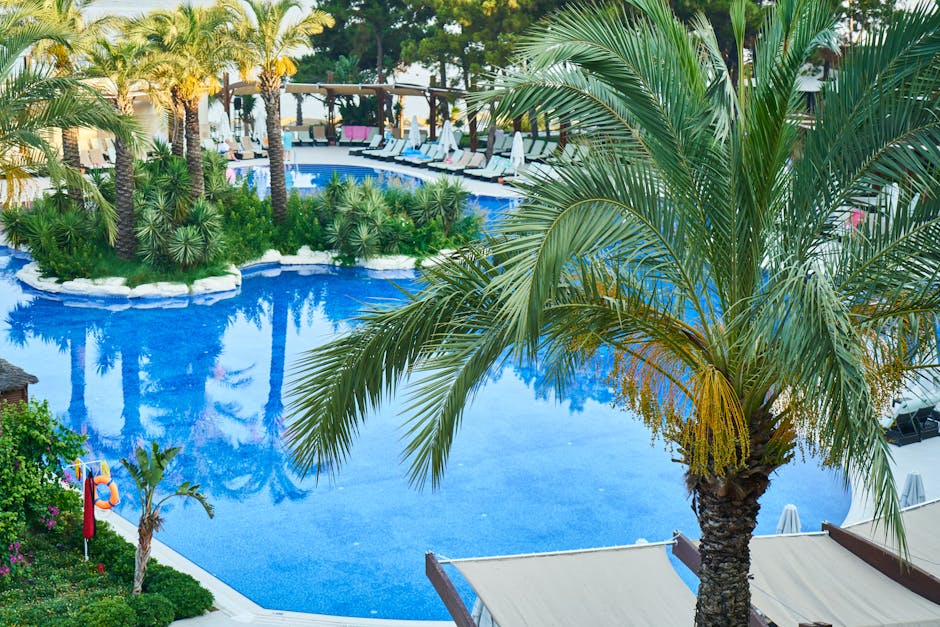
Yes, and it looks great. Palms are one of the few trees that won’t destroy pool plumbing with aggressive roots. The Mediterranean Fan Palm and Windmill Palm are both excellent poolside choices. They don’t drop large leaves into the water like deciduous trees, and their root systems are fibrous rather than invasive.
For ideas on creating that resort feel around a backyard pool, combining palms with subtropical companions like Bird of Paradise, Agave, and ornamental grasses gives you a low-maintenance tropical look that works in zones 9-10.
If you’re in spring maintenance mode and working through your tree care checklist, April is the perfect time to do your first palm feeding right alongside your other spring tree work. Get it all done in the same weekend.
Frequently asked questions
Is Epsom salt good for palm trees? Epsom salt is magnesium sulfate. If your palm has a confirmed magnesium deficiency, it can help as a quick supplement. Apply 2-3 pounds per tree, spread under the canopy, and water in. But it’s not a substitute for a complete palm fertilizer. It provides only magnesium and sulfur, nothing else. A good palm fertilizer already contains magnesium.
How long does it take to fix a nutrient deficiency in palms? Palms are slow. A potassium-deficient palm that starts getting proper fertilizer won’t show visible improvement for 6-12 months. New fronds will emerge healthier, but the damaged lower fronds won’t recover. They’ll eventually be replaced as the tree grows. Manganese frizzle top corrects faster, usually within 2-3 months if you apply manganese sulfate to the soil. Be patient.
Can I use citrus fertilizer on palm trees? Citrus fertilizer is better than lawn fertilizer, but it’s still not ideal. Citrus formulas emphasize nitrogen and usually don’t have the potassium level palms need. If you’re in a pinch, it’ll work for one application. But switch to a proper palm formula next time.
Do palms in containers need different fertilizer? Container palms need the same nutrients but at lower rates. Use the same 8-2-12 palm fertilizer at half the recommended outdoor rate. Container soil dries out faster and fertilizer salts concentrate more quickly. Water thoroughly after feeding to flush salts through the drainage holes.
Should I do a soil test before fertilizing my palm? A soil test is always smart, especially if you suspect micronutrient issues. The UC Davis Analytical Lab does homeowner soil tests for $25-50 depending on the panel. It’ll tell you your soil pH (critical for micronutrient availability) and baseline nutrient levels. If your pH is above 7.5, you’ll almost certainly need supplemental manganese and iron regardless of what else the test shows.